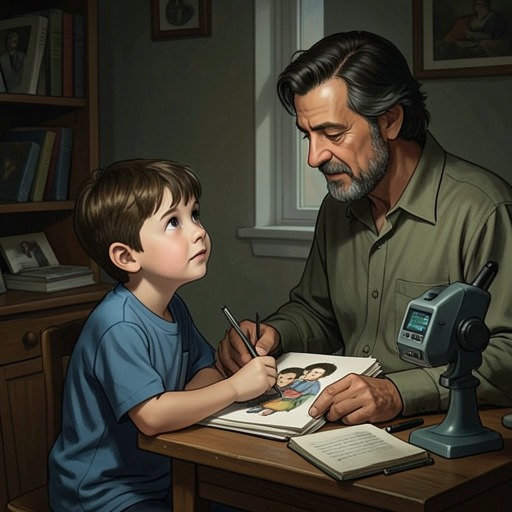
Sandy's portfolio
The Plot Against AmericaSandy's portfolio is both a working archive of his painstaking art and a measure of how abruptly political events can change the meaning of an object. Beneath his bed, it holds drawings made to celebrate admired Americans; after Charles A. Lindbergh's rise begins to seem politically ominous, the portraits become something Sandy says he has destroyed and asks his younger brother to keep secret. The images do not change, but the danger the family reads into them does.
Construction and Place in the Bedroom
For his twelfth birthday, Sandy received a large, flat portfolio of hard black cardboard, sewn to fold along a seam and fastened at the top with two lengths of ribbon tied into a bow. About two feet by a foot and a half, it was too large for the drawers of the boys' dresser and too awkward to stand upright in their crowded shared closet. It therefore lay flat beneath Sandy's bed, beside his spiral sketchpads. That location made the portfolio a practical store for his work, but also placed it close to Philip, who slept nearby and knew what it contained.
The portfolio belonged to a larger practice of patient preparation. Sandy saved his allowance and earnings from chores to buy art supplies over a period of months, and kept his equipment in a grocery carton at the bottom of the bedroom closet. The portfolio gave the drawings he valued most a separate, protected place: each portrait of Charles A. Lindbergh was covered with tracing paper, and Sandy lifted those sheets carefully when he showed the pictures. Its orderly arrangement suggests not a casual assortment, but a collection Sandy had selected and preserved as his best work.
A Record of Admired Americans
The collection began with a work Sandy considered his compositional masterwork: a 1936 picture of his mother pointing overhead at the Paris-bound Spirit of St. Louis. His portfolio also held several large pencil and charcoal portraits of Charles A. Lindbergh, part of a broader series devoted chiefly to prominent Americans whom the Roth parents revered. Among the subjects were Franklin D. Roosevelt and Eleanor Roosevelt, New York mayor Fiorello La Guardia, United Mine Workers president John L. Lewis, and novelist Pearl Buck, whose portrait Sandy copied from a book jacket.
Family members also appear in the portfolio. At least half of those family drawings portray the boys' paternal grandmother, the family's only surviving grandparent. When Uncle Monty brought her to visit on Sundays, she sometimes sat as Sandy's model. Guided by the idea of venerability, he drew the wrinkles in her face and the knots in her arthritic fingers. The careful attention to such details gives the portfolio a double reach: it preserves public figures associated with national life and the particular features of a relative whose daily labor had shaped the family. The drawings' subjects vary, but the portfolio gathers them under the same sustained act of looking.
The Lindbergh Portraits on the Table
A few days after the Winchell broadcast, when the brothers were alone in the house, Sandy brought the portfolio from beneath his bed into the dining room. He opened it on the table and arranged three portraits of Charles A. Lindbergh. In one, Lindbergh wears a leather flying cap, its straps dangling beside his ears; in another, heavy goggles pushed onto his forehead partly conceal the cap; in the third, he is bareheaded, with only his fixed gaze toward the distant horizon to mark him as an aviator.
The sequence varies the signs of the celebrated pilot, moving from flying gear to a face without its most obvious emblem. Yet the portraits do not expose a villain: Sandy's rendering presents a virile hero, courageous adventurer, and figure of apparent strength and rectitude, tempered by a powerful blandness. That visual impression matters because it conflicts with the fear taking hold around the brothers. Sandy tells Philip, "He's going to be president," and adds that Alvin expects Lindbergh to win. Philip responds by pretending the prediction is a joke. The portfolio's images make the political prospect visible in an intimate room, before the seven-year-old can fully comprehend what it might mean.
Secrecy and the Changed Meaning of the Images
Sandy tells Philip not to tell anyone he has the portraits. Philip points out that their parents have already seen them, and Sandy replies that he told them he had torn the drawings up. The contradiction is striking because the narration describes Sandy as exceptionally truthful: he is not ordinarily quiet because he is deceitful, but because he has little reason to hide misconduct. Now he lies about a collection he has preserved, as an external political change makes the drawings signify something they did not signify before.
For Philip, the secret persists beyond this exchange. He repeatedly imagines the drawings in the portfolio beside his bed and cannot bring himself to ask Sandy to move them to the cellar storage bin. His promise not to speak about them constrains him, and his own Lindbergh stamp makes the situation more difficult: he cannot simply reject the figure represented in the pictures. The portraits therefore link the brothers through a shared but uneasy silence. Philip needs the reassurance of his older brother, yet says that the images haunt him and make Sandy seem unreachable.
The portfolio's importance lies in this reversal, not in a change to its contents. It remains a carefully made case of drawings, but its private location, protective tracing sheets, and concealed portraits acquire new significance as the boys' surroundings change. The admired aviator on the page and the feared political future are held together in the same images. By making the portfolio an object of both pride and concealment, the narrative shows how a household's ordinary possessions can become charged with meanings that children recognize before they can explain them.